Command Line Interface (CLI)
dprint <SUBCOMMAND> [OPTIONS] [--] [files]...
Installing and Setup/Initialization
Upgrade
In versions >= 0.30, you can upgrade to the latest version by running dprint upgrade.
Help
The information outlined here will only be for the latest version, so dprint help or dprint help <SUBCOMMAND> (ex. dprint help fmt) will output information on how to use the CLI and give more detail about some of the flags not mentioned here.
Formatting Files
After setting up a configuration file, run the fmt command:
dprint fmt
To format a subset of the files the configuration file matches, you may specify the file paths to format or not format:
dprint fmt **/*.js --excludes **/data
A rare use case, but to override/ignore the patterns in the config file, use the --includes-override and --excludes-override flags:
dprint fmt --includes-override **/*.js --excludes-override **/data
Formatting only git staged files
Requires dprint >= 0.47.0
To format only files that are staged use the --staged flag:
dprint fmt --staged
Note: This requires that git is installed and that you use git for source control.
Formatting only git working directory files
Requires dprint >= 0.55.0
To format only the files with uncommitted changes in the git working directory—staged, unstaged, and untracked (but not gitignored) files—use the --dirty flag:
dprint fmt --dirty
This is useful in editors such as the JetBrains IDEs where the staging area isn't surfaced and you want to format everything you've touched but not yet committed.
Note: This requires that git is installed and that you use git for source control.
Ignoring .gitignore
By default, dprint respects .gitignore files (as well as a repository's .git/info/exclude file) and excludes any gitignored files from formatting. To disable this behaviour, use the --no-gitignore flag:
dprint fmt --no-gitignore
Respecting a global .gitignore
By default, dprint does not respect git's global excludes file (core.excludesFile, defaulting to $XDG_CONFIG_HOME/git/ignore). This is opt-in because it's specific to your machine and won't exist on other machines or CI, so enabling it could cause formatting results to differ between environments.
To opt in, set the DPRINT_GLOBAL_GITIGNORE environment variable to 1:
DPRINT_GLOBAL_GITIGNORE=1 dprint fmt
The global excludes file has the lowest precedence, so a repository's .gitignore or .git/info/exclude can re-include files it ignores. Using --no-gitignore disables it along with all other gitignore handling.
Formatting Standard Input
Use dprint fmt --stdin <file-path/file-name/extension> and provide the input file text to stdin. The output will be directed by the CLI to stdout.
Provide a full file path to format with inclusion/exclusion rules of your dprint configuration file or provide only a file name or extension to always format the file.
Formatting a list of files from Standard Input
Requires dprint >= 0.55.0
Use the --stdin-files flag to read a newline-separated list of file paths to format from stdin instead of passing them as command line arguments. This is useful when piping the output of another tool into dprint:
generate_files | dprint fmt --stdin-files
Unlike piping through xargs, this handles file paths containing spaces since the only delimiter is the newline (blank lines are ignored). It also avoids the command line length limits that apply when passing many paths as arguments.
The paths are resolved against the inclusion/exclusion rules of your dprint configuration file, the same way file patterns passed on the command line are. This flag is also available for the check, file-paths, and format-times subcommands.
Checking What Files Aren't Formatted
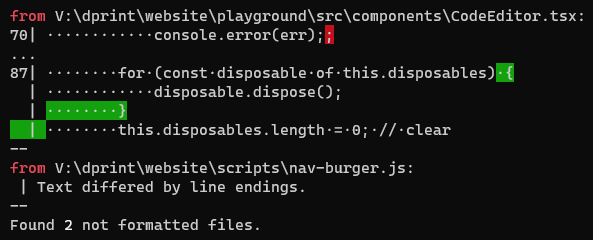
Instead of formatting files, you can get a report of any files that aren't formatted by running:
dprint check
Example output:
List file paths only
Use the --list-different flag to display only the file paths that aren't formatted.
dprint check --list-different
--fail-fast (dprint 0.51+)
Instead of checking every file, you can have the CLI stop on the first failure:
dprint check --fail-fast
Incremental Formatting
By default, dprint will only format files that have changed since the last time you formatted the code in order to drastically improve performance.
If you want to disable this functionality, you may specify --incremental=false on the CLI:
dprint fmt --incremental=false
Alternatively, specify the following in your dprint configuration file:
{
  "incremental": false
  // etc...
}
Using a Custom Config File Path or URL
Instead of the default dprint configuration paths you may specify a path to a configuration file via the --config or -c flag.
dprint fmt --config path/to/my/config.json
# or specify a URL
dprint fmt --config https://dprint.dev/path/to/some/config.json
This flag is more useful for one-off commands. It is recommended to use the default configuration file location and name as that will lead to a better user experience.
Changing Config Discovery
Starting in dprint 0.50, you can change the way dprint discovers configuration files by using the --config-discovery flag:
--config-discovery=default(default) - Discovers configuration files in the current directory, ancestor directories, and descendant directories while searching for files to format.--config-discovery=ignore-descendants- Discovers configuration files in the current directory and ancestor directories only.--config-discovery=global- Use the global config file only (dprint 0.51+)--config-discovery=false- Disables all configuration discovery (specify either--config=<path>or--plugins <url-or-path>).
Note this can also be set via the DPRINT_CONFIG_DISCOVERY environment variable (ex. DPRINT_CONFIG_DISCOVERY=false, DPRINT_CONFIG_DISCOVERY=global, etc.)
Coloured Output
By default, dprint colours its output (for example, the diffs shown by dprint check and dprint fmt --diff). Unlike many tools, it emits colours regardless of whether the output is a terminal, so colours show up in CI logs as well. This is controlled by two environment variables:
NO_COLOR- Set to any non-empty value to disable coloured output. See no-color.org.FORCE_COLOR- Set to any non-empty value to force coloured output on, even whenNO_COLORis set. Takes precedence overNO_COLOR.
# disable colours
NO_COLOR=1 dprint check

# re-enable colours in an environment that sets NO_COLOR
FORCE_COLOR=1 dprint check
Exit codes
0- Success1- General error10- Argument parsing error11- Configuration resolution error12- Plugin resolution error13- No plugins found error14- No files found error (or suppress to0with--allow-no-filesin dprint >= 0.43)20-dprint checkfound non-formatted files, ordprint fmt --fail-on-changeformatted files
Shell completions
Shell completions can be generated by running dprint completions <shell>.
Supported shells:
bashelvishfishpowershellzsh
Example (bash):
dprint completions bash > /usr/local/etc/bash_completion.d/dprint.bash
source /usr/local/etc/bash_completion.d/dprint.bash
Diagnostic Commands and Flags
Outputting file paths
Sometimes you may not be sure what files dprint is picking up and formatting. To check, use the file-paths subcommand to see all the resolved file paths for the current plugins based on the CLI arguments and configuration.
dprint file-paths
Example output:
C:\dev\my-project\scripts\build-homepage.js
C:\dev\my-project\scripts\build-schemas.js
C:\dev\my-project\website\playground\config-overrides.js
C:\dev\my-project\website\playground\src\components\ExternalLink.tsx
C:\dev\my-project\website\playground\src\components\index.ts
C:\dev\my-project\website\playground\src\components\Spinner.tsx
...etc...
Outputting resolved configuration
When diagnosing configuration issues it might be useful to find out what the internal lower level configuration used by the plugins is. To see that, use the following command:
dprint resolved-config
Example output (JSON):
{
  "typescript": {
    "arguments.preferHanging": true,
    "arguments.preferSingleLine": false,
    "arguments.trailingCommas": "onlyMultiLine",
    "arrayExpression.preferHanging": true,
    "arrayExpression.preferSingleLine": false,
    "arrayExpression.trailingCommas": "onlyMultiLine",
    "arrayPattern.preferHanging": true,
    // ...etc...
    "whileStatement.singleBodyPosition": "nextLine",
    "whileStatement.spaceAfterWhileKeyword": true,
    "whileStatement.useBraces": "preferNone"
  },
  "json": {
    "commentLine.forceSpaceAfterSlashes": true,
    "indentWidth": 2,
    "lineWidth": 160,
    "newLineKind": "lf",
    "useTabs": false
  }
}
Optionally use the --file flag to limit the output to only the plugins that would format that file. This is useful for verifying which plugins are actually associated with a file:
dprint resolved-config --file path/to/file.py
Outputting format times
It can be useful to know what files take a long time to format as you may consider skipping them. To see this information, use the following command:
dprint format-times
Example output:
0ms - C:\dev\my-project\dprint.json
0ms - C:\dev\my-project\README.md
1ms - C:\dev\my-project\other-file.md
2ms - C:\dev\my-project\package.json
2ms - C:\dev\my-project\my-markdown-file.md
4ms - C:\dev\my-project\test.ts
5ms - C:\dev\my-project\docs\info.md
16ms - C:\dev\my-project\my-file.ts
46ms - C:\dev\my-project\docs\overview.md
54ms - C:\dev\my-project\build.js
Outputting incremental state (advanced, for very large repositories)
When incremental formatting is enabled, dprint keeps a cache and reuses it as long as nothing that affects formatting output has changed. The whole cache for a configuration file is thrown away when its plugins, plugin versions, resolved configuration, associations, overrides, or global configuration change.
The incremental-state subcommand prints the exact signal dprint uses to make that decision, so you can compare it between two revisions and find out ahead of time whether the cache would be reused or invalidated:
dprint incremental-state
Example output (JSON):
{
  "configs": [
    {
      "path": "/home/david/dev/my-project/dprint.json",
      "hash": "3f9c2a7b1e4d8f60",
      "plugins": [
        { "name": "dprint-plugin-typescript", "version": "0.95.15" },
        { "name": "dprint-plugin-json", "version": "0.21.1" }
      ]
    }
  ]
}
A configs entry is emitted for every configuration file dprint discovers (including descendant configuration files), each with the hash that gates its incremental cache. The hash is the only thing that matters for cache invalidation—the plugins list is included so the output is easy to inspect when a hash changes. The output is deterministic across machines for an unchanged configuration.
This is useful in CI to avoid formatting the entire repository when only a few files changed. For example, format only the files in the changeset when the cache would survive, and otherwise fall back to formatting everything:
git checkout main
previous_state=$(dprint incremental-state)
git checkout "$BRANCH"
new_state=$(dprint incremental-state)

if [ "$previous_state" != "$new_state" ]; then
  # plugins or configuration changed—the cache is invalid, so format everything
  dprint fmt
else
  # the cache is still valid, so only format the changed files
  dprint fmt $(git diff --name-only main...)
fi
Log Level
To adjust your logging level, use the --log-level flag (defaults to --log-level=info).
silent- Outputs nothing.error- Outputs fatal error messages.warn- Additionally outputs warnings.info- Additionally outputs informational messages.debug- Additionally outputs debug messages.
Debug Logging
Take note that --log-level=debug is very useful to see what's going on under the hood.
For example:
dprint check --log-level=debug
Example output:
[DEBUG] Getting cache directory.
[DEBUG] Reading file: C:\Users\user\AppData\Local\Dprint\Dprint\cache\cache-manifest.json
[DEBUG] Checking path exists: ./dprint.json
[DEBUG] Reading file: V:\dev\my-project\dprint.json
[DEBUG] Globbing: ["**/*.{ts,tsx,js,jsx,json}", "!website/playground/dist", "!scripts/build-website", "!**/dist", "!**/target", "!**/wasm", "!**/*-lock.json", "!**/node_modules"]
[DEBUG] Finished globbing in 12ms
[DEBUG] Reading file: C:\Users\user\AppData\Local\Dprint\Dprint\cache\typescript-0.19.2.compiled_wasm
[DEBUG] Reading file: C:\Users\user\AppData\Local\Dprint\Dprint\cache\json-0.4.1.compiled_wasm
[DEBUG] Creating instance of dprint-plugin-typescript
[DEBUG] Creating instance of dprint-plugin-jsonc
[DEBUG] Created instance of dprint-plugin-jsonc in 9ms
[DEBUG] Reading file: V:\dev\my-project\website\playground\tsconfig.json
[DEBUG] Reading file: V:\dev\my-project\website\assets\schemas\v0.json
[DEBUG] Reading file: V:\dev\my-project\dprint.json
[DEBUG] Formatted file: V:\dev\my-project\website\assets\schemas\v0.json in 2ms
[DEBUG] Formatted file: V:\dev\my-project\dprint.json in 0ms
[DEBUG] Formatted file: V:\dev\my-project\website\playground\tsconfig.json in 0ms
[DEBUG] Created instance of dprint-plugin-typescript in 35ms
[DEBUG] Reading file: V:\dev\my-project\website\playground\public\formatter.worker.js
[DEBUG] Reading file: V:\dev\my-project\website\assets\formatter\v1.js
[DEBUG] Reading file: V:\dev\my-project\website\playground\src\plugins\getPluginInfo.ts
[DEBUG] Formatted file: V:\dev\my-project\website\playground\public\formatter.worker.js in 22ms
[DEBUG] Formatted file: V:\dev\my-project\website\assets\formatter\v1.js in 6ms
[DEBUG] Formatted file: V:\dev\my-project\website\playground\src\plugins\getPluginInfo.ts in 4ms
...etc....
This may be useful for finding files that are taking a long time to format and maybe should be excluded from formatting.
Clearing Cache
Internally, a cache is used to avoid re-downloading files. It may be useful in some scenarios to clear this cache by running:
dprint clear-cache